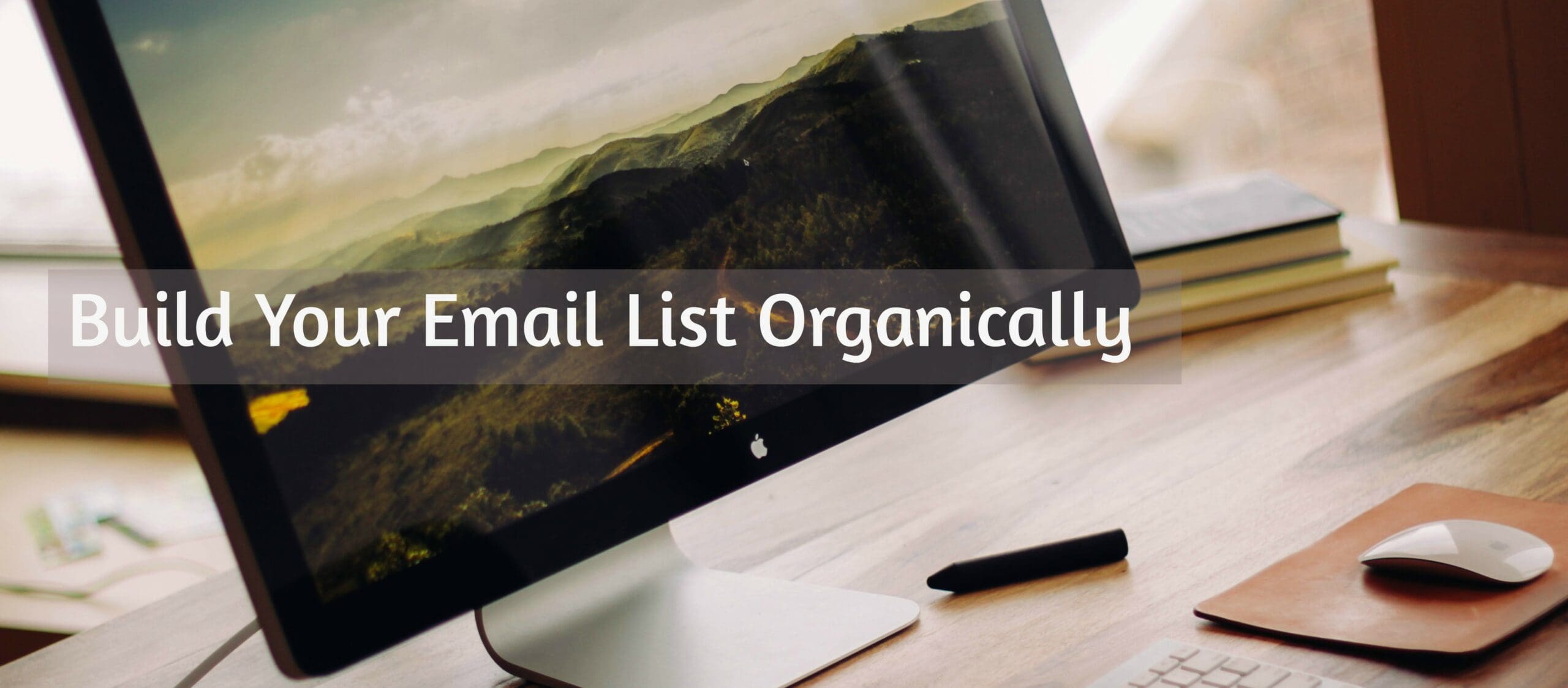
 If you want to start an email campaign for your business, you might be tempted to buy a list of leads. Before you do that, I would suggest something even better, and that's building an organic list from your website. Why? Building your email list organically ensures that your leads will actually want to hear from you. It will result in less opt-outs and getting marked as spam. If you get marked as spam too many times, you run the risk of being "blacklisted" or blocked from email servers. If you're new to this, do not fear. You can build your own list through website lead generation.
Lead generation online consists of building a list of qualified individuals who are interested in your products or services. You can collect this information through forms and calls to action (CTA) on your website. How do you get visitors to fill out forms? Offer something of value. People will exchange their contact information for something that benefits them or sparks their interest. At minimum, you want to collect a name and email address. However, for more extensive offers, you can ask for a mailing address and phone number. Make sure you don't ask for too much information upfront, as it will cause people to bounce off the page. Are you ready to start building your email list? Here are a few different campaigns you can use to start generating leads on your website:
Is your business taking advantage of offering discounts online? Now, this may seem like a no-brainer, but sometimes the best way to get somebody to initiate contact is through an old-fashioned freebie. Giving an attractive discount, free sample, or trial offer can attract leads that otherwise would have kept on clicking. How to do it: Incorporate a free offer or discount into a landing page, pay-per-click ad, or social media ad. Make sure you pick one goal for the user and focus your landing page around that. Learn more about landing pages here.
To blog or not to blog, that is the question. When you blog for your businesses, you create the opportunity to attract new leads by positioning yourself as a thought leader in your industry. You can also position yourself as an expert by creating educational videos, downloadable guides, white-papers and E-books. Offering exclusive content is a great way to build your list and generate leads. How to do it: Integrate a sign up form with your content offer at the end of a blog post or on a landing page. Blog posts are great because your audience is already reading your material and might want more information. Having trouble coming up with content? Read our tips on overcoming writer's block.
You know you love the camera. If not, that’s okay. You can still host an online class or webinar via podcast or voiceover. Do it live or send out recorded sessions—the choice is yours. There’s endless options for connecting with potential leads all over the world now, and turning your office into a virtual classroom. How to do it: Develop your content and promote your class via a landing page that can be shared through ads, social media or on your website. People will exchange their contact info in exchange for the free class. If it’s good enough, it may convert them to a customer! Alright, I have to go do some online shopping. And my coffee is cold. Cue the end of this blog post. Thanks for reading and check back for more marketing tips and lead generation ideas!
 Having spent most of the last two decades planning, developing and marketing websites, I've learned a lot about what works and what doesn't when marketing your business online. For the most part, I can sum up website planning in one word: relationships. Thousands of books and articles have been written about building relationships online. In the end, it isn't any different than building relationships offline. Business relationships are often compared to dating. The metaphor works in the sense that you start by talking a little, then maybe go out for coffee... Over time, a lot of other stuff happens until, shazam! One day you get married. The point here is that beginning a relationship with a marriage proposal pretty much never works. And if it does, your odds of marrying a desperate, toxic nut-job are pretty high.
I think a better comparison is a student-teacher relationship. Outside of our marketing agency, I teach scuba. I am passionate about diving, especially deep diving, using exotic breathing gasses and hundreds of pounds of highly specialized equipment. Although a student brand new to diving has no need to understand the effects of high oxygen partial pressures on the human body, my expertise is never questioned. The rationale being that if I can survive dives in excess of 100 meters, breathing gasses I mixed myself, surely I must be qualified to teach a new diver to swim around in the top 60 feet or so. When that same diver is ready to buy equipment, who do you think he/she goes to? My students won't even consider making a purchase without talking to me first. That concept translates to virtually every business relationship and should form the basis of your website planning. Reno web design and website planning is relationship planning.
The absolute first rule in website planning is to make sure the right people see it. 7/11 stores are located on busy neighborhood intersections because people who like Slurpees live there. In today's world, 'busy intersection' means Google's search engine results page (SERP). If you stop reading right here, take away this one concept: Make a plan to reach your audience in Google search before you even think about website design. I see it over and over. Clients toil over every pixel and make countless revisions spanning months to make their websites "perfect" before allowing us to take them live.
Meanwhile, not one human being is exposed to their business online. With this in mind, website planning essentially means Google planning. I've never been comfortable with the term, search engine optimization (SEO). Partly, that's because so many of the people and agencies that claim to be SEOs fall somewhere between incompetent and crooked. I just don't want to be lumped in with that group. I also don't think SEO is as hard as it is time consuming. At least, not for most businesses.
After over a decade resisting the term "SEO," I've grudgingly come to embrace it. If you want your website to bring you customers, you have to play by Google's rules. That means the written text has to take priority over design. Yet, I'm told over and over, "people don't read online." Really? Scores of bloggers make their living writing content people read online. It is more accurate to say, "people don't read boring crap online."
The fact is, people DO read online. They read a lot. It's just that they are very choosey about what they read. If you are a sucky writer, don't expect people to read your sucky writing just because you want them to. Be the expert in your business, but hire pros to do the writing for your website. A website writer must understand how to write engaging content for humans that also supports the relevancy requirements for search engine rankings. Writing for SEO purposes is an essential website planning strategy.
The myth that people "don't read on the internet" is partly made believable because large blocks of text are miserable to read online. You can solve that problem by making content readable. Unless and until we (we being OCG Creative) bring it up, typography never enters the conversations about website planning we have with our clients.
Typography includes all the elements related to your website's written content. The creative use of headings, type styles, font choices, sizes, color, italics, bolding, lists, etc. all contribute to the readability of your website content. Website text must be well-sectioned and scannable by the reader. Online readers will scan your page for specific terms in about 2 seconds before deciding whether to read it or go back to Google and search some more. Therefore, it is essential that typography be central to your website planning.
Right from the start, accept that your website will never be done. Your planning process must include a strategy for ongoing updates. In nearly every instance, websites that are easy to update get more attention than those that aren't. Generally speaking, the more complex the website design, the more difficult it is to make changes. Plan your website for your visitors, not your designer, or worse, your ego.
It's funny. Our Reno web design team ask new clients every day to describe what elements they feel are most important to their websites. 9 times out of 10, the first word they'll use is "clean." Yet, 9 times out of 10, the same client will want everything he or she can think of thrown in once the design phase begins. At the same time, all attention shifts away from content and search engine rankings in favor of graphics.
By now, it should be clear that search engine rankings and speed win out over everything else about your website. Once you make it to the top of Google, you'll have the luxury of dialing in your website for conversions. At that point, you can make all the design changes you want. But early on, plan your website around rankings. I promise you'll thank me later.
Local search engine optimization, lovingly referred to as local SEO, is an integral part of any businesses local marketing initiatives. When a business has a great search engine optimization strategy, its search ranking can be expected to be higher. The higher a search rank, the greater propensity for potential customers to visit your website and ultimately purchase your product or service. (more…)